#10

Electrostatics

#10.1

Our services

From the measurement on site to the assessment of your process and the training of your teams: we cover the whole electrostatic risk chain.

#01

Electrostatic measurements

  • Surface, earth-leakage and powder track resistance (IEC 60079-0, IEC 61340-2-3, IEC 60079-32-2)
  • Capacitance of un-earthed parts, leakage resistance of components and equipotential bonding (BCI 8)
  • Transferred charge (IEC 60079-0, IEC 60079-32-2, ISO 80079-36 Annex D)
  • Relaxation time, electrostatic fields and potentials
  • Charge density of products and surface charge density (rhysafe test methods)
#02

Risk assessment and modelling

  • Assessment of electrostatic ignition sources in your processes according to TRGS 727 and IEC TS 60079-32-1
  • Cone discharges in silos and containers: electric field at the powder/air interface with our published model
  • Safe filling rates and practical measures: earthing, conductive equipment, process parameters
#03

Tailor-made training

  • Courses built around your own installations and products
  • Interactive 3D models that make invisible charges visible
  • For operators, engineers and safety managers, on site or online

#10.2

Training materials

We turn our methods into interactive materials that make invisible charges visible, and we build trainings around your own equipment.

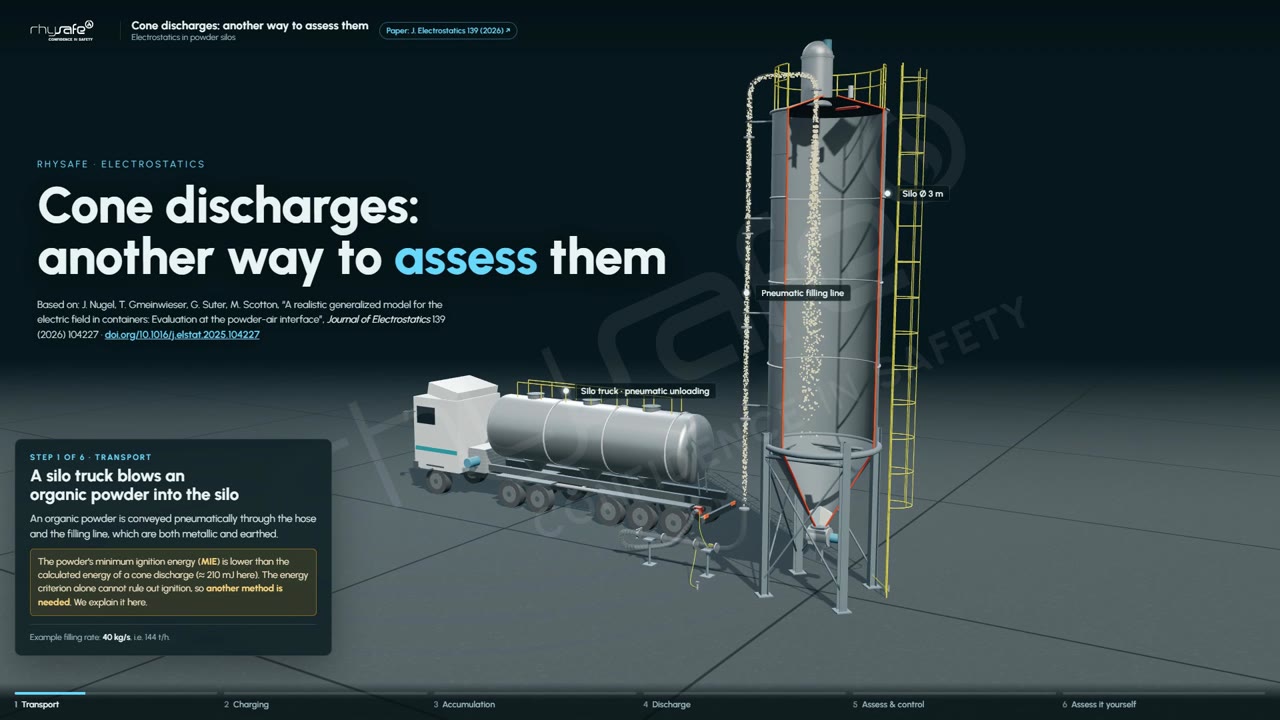
Interactive animation of a silo filled by a silo truck, with the charged powder heap and the electric field
#Interactive animation

Cone discharges in silos: another way to assess them

From the silo truck to the electric field at the powder/air interface: our silo publication explained step by step.

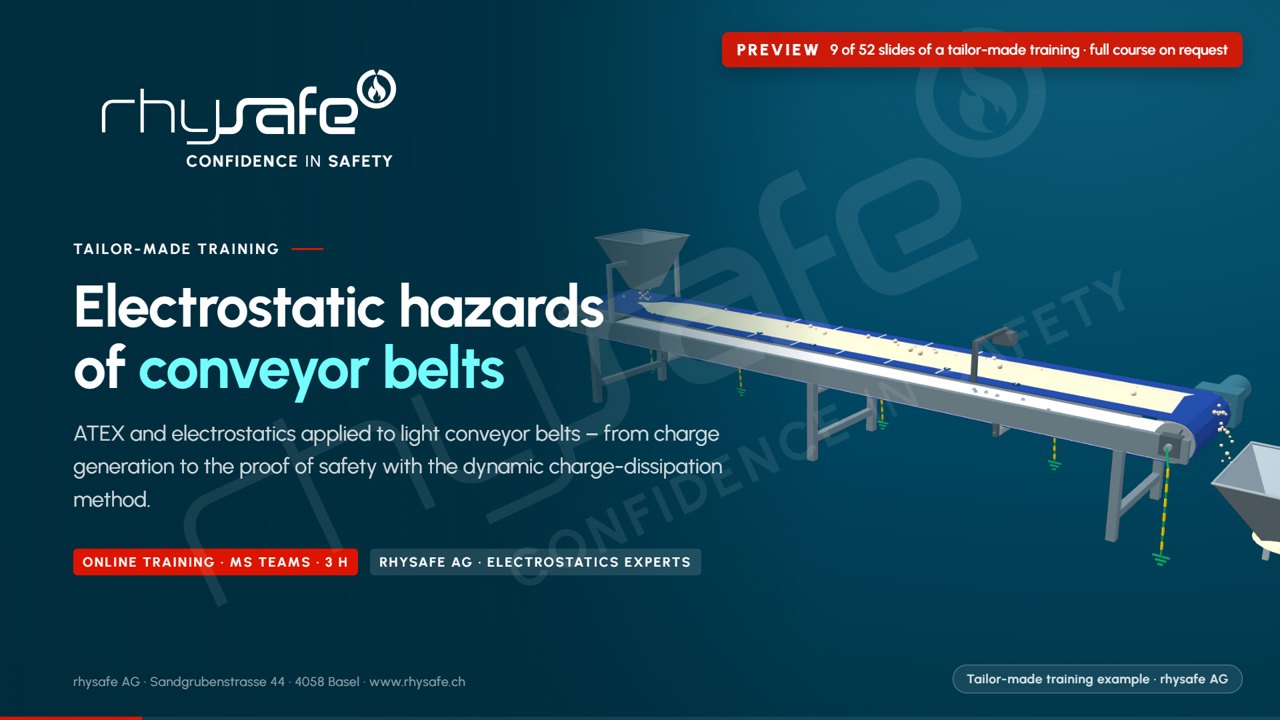
Title slide of a tailor-made training on electrostatic hazards of belt conveyors
#Training example

Electrostatic hazards of belt conveyors

A preview (9 of 52 slides) of a course we built for a client, with interactive 3D conveyor models. We design trainings like this one around your own equipment.


#10.3

Publications

Our experts publish their methods in peer-reviewed journals.

#Journal of Electrostatics · Elsevier · 2026

A realistic generalized model for the electric field in containers: Evaluation at the powder-air interface

J. Nugel, T. Gmeinwieser, G. Suter, M. Scotton · Vol. 139, 104227

Cone discharges in silos: the electric field is assessed where ignition can actually happen, at the powder/air interface, for any cone angle of the powder heap.

#Chemical Engineering Transactions · AIDIC · 2025

A generalized model for the electric field in silos/containers

J. Nugel, M. Scotton, G. Suter · Vol. 116, 547–552

Estimates the maximum wall field in a silo without finite-element modelling, with and without charge relaxation.


#10.4

Cone discharges and static electricity on belt conveyors

Two common electrostatic ignition sources in the storage and handling of powders and bulk solids. Here is how they arise and how we assess them.

#Silos and containers

Cone discharges in silos

A cone discharge (also called a bulking brush discharge) can occur when a silo or a large container is filled with an insulating, charged powder or granulate, for example after pneumatic conveying. The charge builds up in the powder heap. When the electric field at the surface of the cone reaches the breakdown field of air, about 3 MV/m, discharges run along the cone towards the silo wall.

Their energy grows with the silo diameter and can reach several hundred millijoules. That is enough to ignite many combustible dusts, let alone solvent vapours or hybrid mixtures. When the minimum ignition energy (MIE) of the product is below the estimated discharge energy, the energy criterion alone no longer gives an answer.

What we do

  • Electric field at the powder/air interface, calculated with our published model (Journal of Electrostatics, 2026)
  • Maximum filling rate without cone discharges, from charge density, resistivity and silo geometry
  • Laboratory and on-site measurements: resistivity, relaxation time, charge density of the product
  • Protective measures to IEC TS 60079-32-1 and TRGS 727
#Bulk handling

Static electricity on belt conveyors

On a belt conveyor, the belt is charged continuously by contact and separation: on the pulleys, on the idlers and by the conveyed product. An insulating conveyor belt can therefore reach very high potentials.

The result can be sparks from un-earthed conductive parts (idlers, pulleys, frame), brush discharges from the belt surface and even highly energetic propagating brush discharges. In hazardous areas, IEC TS 60079-32-1 and TRGS 727 require, depending on the zone and the belt speed, a dissipative belt and earthing of all conductive parts, or proof by testing that the transferred charge stays below the limits of the explosion group.

What we do

  • Surface and leakage resistance of belt and idlers
  • Transferred charge (IEC 60079-0, IEC 60079-32-2)
  • Dynamic charge-dissipation test on the running belt
  • Assessment of the whole conveyor and training of your teams

Frequently asked questions

What is a cone discharge?

An electrostatic discharge that starts at the top of the insulating, charged powder heap during filling and runs along its surface to the silo wall. IEC TS 60079-32-1 lists it among the discharge types to be considered in explosive atmospheres.

When are cone discharges a concern?

When a highly insulating product (high volume resistivity) enters a large-diameter silo with a high charge, for instance after pneumatic conveying. The risk rises with the filling rate, because the charge has less time to leak away to the earthed wall.

How can cone discharges be avoided?

By limiting the filling rate or the product charge, by reducing the container diameter, or, for very sensitive products, by avoiding the explosive atmosphere (inerting). Our model gives the maximum filling rate at which the field stays below the breakdown field of air.

Can a conveyor belt ignite an explosive atmosphere?

Yes, if the belt is insulating or if conductive parts are not earthed. In hazardous areas you use a dissipative belt, earth idlers, pulleys and frame, or prove by testing that the discharges stay too weak to ignite the atmosphere.

Which standards apply?

Mainly IEC TS 60079-32-1, the reference guide on static electricity in explosive atmospheres, and the German TRGS 727, widely used as the state of the art in Switzerland. The measurement methods are described in IEC 60079-32-2.